The Difference Between “Nakute” and “Natte” in Japanese Grammar
Have you ever frozen for a second, wondering whether to say “Nakute” or “Natte”?
You are not alone! Many of my students tell me, “They sound so similar, I keep mixing them up!”
Even though they sound alike, they carry completely different meanings:
- 🌞 Nakute: Describes a state of ‘not being’.
- 🌞 Natte: Describes a ‘change of state.’
In this post, I’ll break down the logic behind these two forms with simple examples like money, health, and weather, so you never have to hesitate again!
Q&A: What is the difference between “Nakute” and “Natte”?
Student Question:
“Recently, I have been having trouble separating ‘なって’ (Natte) and ‘なくて’ (Nakute). They look and sound different, but I keep getting them mixed up!”
It’s a very common challenge! The key is looking at the original verb. One is about “not being,” and the other is about “becoming.” Here is a quick visual guide:
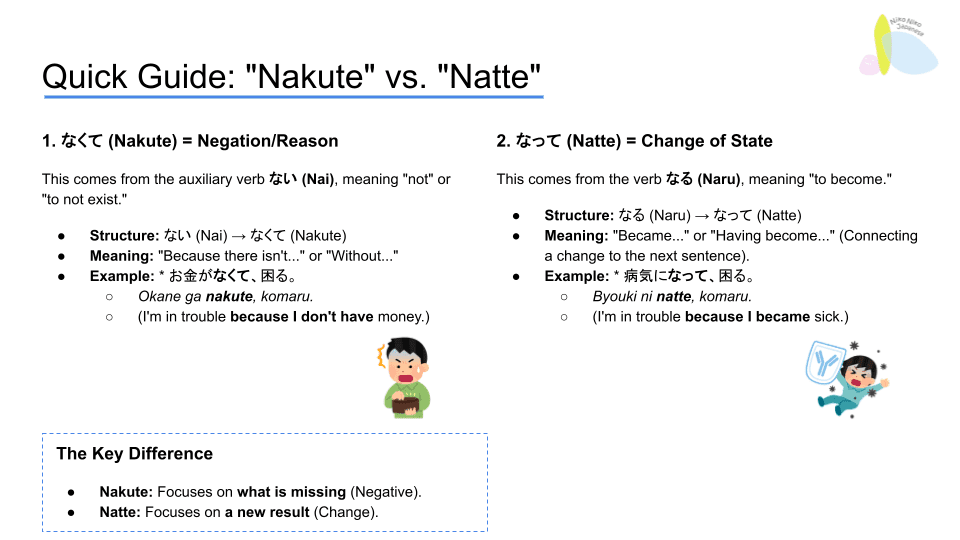
▲ Comparison: “Because I don’t have money” vs “Because I became sick”
Another Example: Weather
To see the difference in a daily context, let’s look at the temperature:
今日はあつくなくて、過ごしやすいね。
(It’s not hot today, so it’s pleasant.)
午後からあつくなって、汗をかいた。
(It became hot in the afternoon, so I sweated.)
仕事がいそがしくなくて、ひまです。
(I’m not busy with work, so I have free time.)
急に仕事がいそがしくなって、大変です。
(Work suddenly became busy, so it’s tough.)
病気じゃなくて、よかったです!
(It’s not an illness, I’m so relieved!)
病気になって、会社を休みました。
(I became sick, so I took a day off.)
Do you have a Japanese grammar question? Feel free to ask!
🧐 Wait! Why is it “病気じゃなくて” and not “病気なくて”?
Many learners ask: “Since ‘Nai’ means ‘not’, why can’t I just say ‘Byouki nakute’?”
Focus: Negating an Identity
It means: “It is NOT [Noun].”
病気じゃなくて (Byouki ja-nakute):
“It is not an illness.” (e.g., I was just tired, not actually sick).
Logic: 病気だ → 病気じゃない → 病気じゃなくて…
Focus: Negating Existence
It means: “There is NO [Noun].”
病気(が)なくて (Byouki ga nakute):
“There are no illnesses (in this world/town).”
⚠️ Sounds strange here!
You’re talking about your condition, not the concept of disease itself.
💡 The Secret: It depends on WHAT you are negating!
Are you saying “It’s not X” or “There is no X”?
| Expression | English Meaning | The Focus |
|---|---|---|
| 病気じゃなくて | It’s not a sickness. | Identity (What is it?) |
| お金がなくて | There is no money. | Existence (Is it there?) |
Still confused about your specific sentence?
Languages can be tricky, and context is everything!
If you have a specific phrase you’re unsure about, feel free to ask me directly.
I’m here to help you find the right words for your Japanese journey.