Japanese Grammar: 3 Uses of 〜ています (te imasu) | More Than “-ing”
Japanese Grammar Guide
〜ています (te imasu)
More Than Just “-ing”!
Did you know that 〜ています can describe not only what you are doing right now, but also your habits and current situations?
Let’s explore three common uses with simple examples.
1. Actions in Progress
What are you doing right now?
Use 〜ています to describe an action happening at a particular point in time.
今、日本語を勉強しています。
I am studying Japanese now.
母は料理をしています。
My mother is cooking.
Question:
今、何をしていますか。
What are you doing now?
In English, we usually use be + verb-ing for actions happening right now.
Japanese: Verb て-form + います
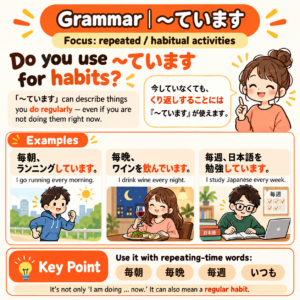
2. Regular or Repeated Activities
What do you do regularly?
Use 〜ています for activities that are performed regularly or repeatedly.
毎朝、コーヒーを飲んでいます。
I drink coffee every morning.
毎週、日本語を勉強しています。
I study Japanese every week.
Question:
週末は何をしていますか。
What do you usually do on weekends?
In English, we often use the simple present tense for regular activities.
But in Japanese, we can use 〜ています.
3. Situations or States
What is your current situation?
〜ています can also describe a current situation or state. Some states are the result of a past action.
結婚しています。
I am married.
東京に住んでいます。
I live in Tokyo.
眼鏡をかけています。
I am wearing glasses.
窓が開いています。
The window is open.
〜ています does not always mean “am / is / are + -ing” in English.
It can describe someone’s current situation or the state of an object.
Action or State?
Let’s compare these two sentences.
窓を開けています。
I am opening the window.
Focus: The action is happening.
窓が開いています。
The window is open.
Focus: The current condition of the window.
Notice the difference between 開ける (to open something) and 開く (something opens).
Let’s Practice!
Identify the meaning of 〜ています in each sentence.
A: Action in progress
B: Regular activity
C: Situation or state
Check Your Answers / 答えを見る
1. A — Action in progress
I am watching TV now.
2. C — Situation or state
I live in Osaka.
3. B — Regular activity
I run every day.
4. C — Situation or state
The door is closed.
Summary
① Action in progress
I am studying Japanese now.
今、日本語を勉強しています。
② Regular activity
I drink coffee every morning.
毎朝、コーヒーを飲んでいます。
③ Situation or state
I live in Tokyo.
東京に住んでいます。
One grammar form, several meanings!
The meaning depends on the verb and the context.

“Japanese Grammar: 3 Uses of 〜ています (te imasu) | More Than “-ing”” に対して1件のコメントがあります。